


Sciatica pain is a type of nerve pain that occurs along the path of the sciatic nerve. This nerve is the longest in the body it runs from the lower back down through the hips buttocks and down each leg. When the sciatic nerve is compressed or irritated, it can cause pain, numbness or tingling sensations in the lower back and legs. Sciatica pain can vary in intensity, duration and can be a mild discomfort or a debilitating condition that affects daily activities.
Five effective exercises for sciatica pain relief include the knee-to-chest stretch, glute stretch, cat-camel stretch, bird-dog exercise, and standing hamstring stretch. These movements can help by gently stretching muscles, improving mobility, and reducing pressure on the sciatic nerve. Always consult a doctor or physical therapist before starting a new exercise program and stop immediately if an exercise increases your pain.
| Exercise | How to Do It | Hold / Reps | Extra Tips |
|---|---|---|---|
| 1. Knee-to-Chest Stretch | Lie on your back with knees bent and feet flat. Pull one knee toward your chest with your hands. Repeat on the other side. | Hold 30 seconds each side. | For a deeper stretch, keep one leg straight while pulling the other knee toward your chest. |
| 2. Glute Stretch (Figure-4 Stretch) | Lie on your back, knees bent. Cross one ankle over the opposite thigh. Pull the grounded leg toward your chest until you feel the stretch. | Hold up to 30 seconds per side. | Make sure your back stays relaxed against the floor. |
| 3. Cat-Camel Stretch | Begin on hands and knees (hands under shoulders, knees under hips). Arch your back upward (“cat”), then drop your belly downward (“camel”). | Repeat slow, controlled reps (8–12 times). | Move gently and breathe with each transition. |
| 4. Bird-Dog Exercise | On hands and knees, engage core. Extend right arm forward and left leg back. Return to start, then switch sides. | Hold each side a few seconds, repeat 8–12 reps per side. | Keep your spine neutral avoid letting your back sag. |
| 5. Standing Hamstring Stretch | Stand and place one foot on a raised surface (heel down, toes up). Keeping back straight, hinge forward at your hips until you feel the stretch. | Hold 20–30 seconds per leg. | Don’t round your back lean from the hips for best results. |
Knee to Chest Stretch
Stretching the glutes and lower back muscles. To perform this stretch:
- Lie on your back with your legs extended.
- Slowly bend your right knee and bring it up towards your chest.
- Grasp your right knee with both hands then gently pull it towards your chest until you feel a stretch in your glutes and lower back.
- Hold the stretch for 15-30 seconds, then slowly release.
- Repeat with your left leg.
- Perform 2-3 sets of 10-15 repetitions on each leg.
Note: If you feel any pain or discomfort during the stretch, stop immediately and consult with your doctor or physical therapist.
Child’s Pose
Child’s Pose is a gentle yoga pose that can help to relieve sciatica pain. It stretches the lower back, hips and thighs, which can help to release tension and ease pain. To do the Child’s Pose, follow these steps:
- Begin on your hands and knees, with your hands shoulder-width apart and your knees hip-width apart.
- Slowly lower your hips back towards your heels, keeping your arms extended in front of you.
- Rest your forehead on the mat and allow your spine to lengthen.
- Take deep breaths and hold the pose for 30 seconds to 1 minute.
- Slowly come back to a seated position.
Repeat this stretch several times throughout the day to help relieve sciatica pain.
Pigeon Pose
Pigeon pose is a yoga stretch that can help alleviate sciatica pain by opening up the hips and stretching the piriformis muscle. To perform this stretch, start in a downward-facing dog position, then bring your right leg forward, placing your knee behind your right hand and your ankle behind your left hand. Slowly lower your body onto your right leg and stretch your left leg behind you. Keep your torso straight and reach your arms out in front of you. Hold for 30 seconds, then switch legs and repeat.
Hamstring Stretch
- Begin by lying on your back with your knees bent and your feet flat on the floor.
- Straighten one leg and lift it toward the ceiling, grasping the back of your thigh with both hands.
- Gently pull your leg toward you until you feel a stretch in the back of your thigh and behind your knee.
- Hold the stretch for 15 to 30 seconds, then release and repeat with the other leg.
- You can also do this stretch while sitting on the floor with your legs straight in front of you, reaching forward to touch your toes or ankles.
Seated Spinal Twist
The seated spinal twist is a yoga pose that can help to relieve sciatica pain by stretching the lower back and glutes. Here are the steps to perform the seated spinal twist:
- Sit on the floor with your legs straight out in front of you.
- Bend your right knee and place your right foot on the outside of your left knee.
- Place your left elbow on the outside of your right knee.
- Inhale and sit up tall, lengthening your spine.
- Exhale and gently twist to the right, using your left elbow to deepen the stretch.
- Hold the pose for 30 seconds to 1 minute.
- Release the twist and repeat on the other side.
What is Different in Sciatica Pain

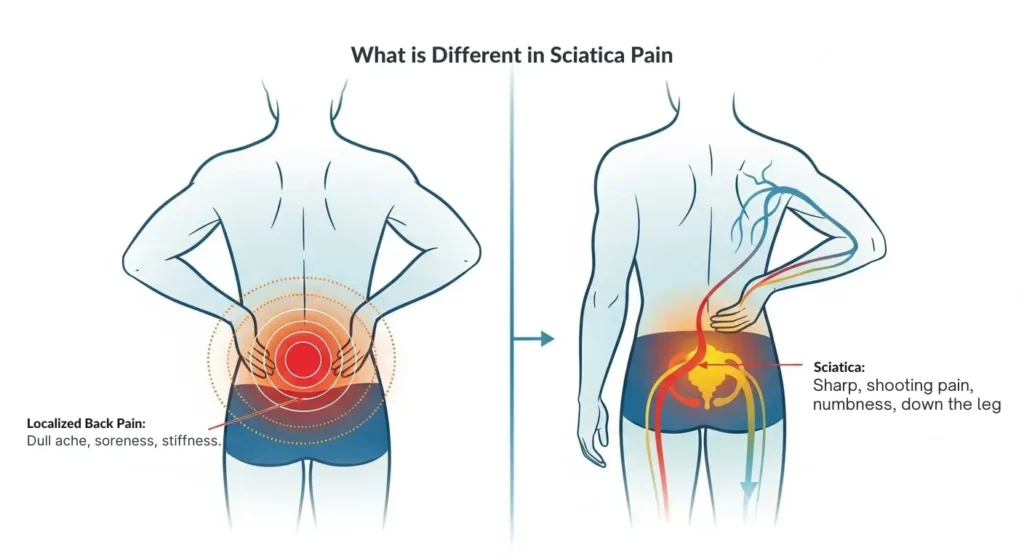
Sciatica is different from general lower back pain because it involves a sharp, burning, or “electric shock” type of pain that radiates from the lower back or buttock down one leg, often extending to the foot. Unlike regular back pain, sciatica is characterized by this nerve-related pain that can be accompanied by numbness, tingling, or muscle weakness in the affected leg, and it is often worsened by coughing, sneezing, or sitting for long periods.
Key differences in sciatica pain:
- Pain location and radiation: Instead of just a local backache, the pain travels along the path of the sciatic nerve. It starts in the lower back or buttock and shoots down the back or side of one leg.
- Pain quality: The pain is often described as sharp, shooting, burning, or like an electric shock, rather than just a dull ache.
- Neurological symptoms: It can cause numbness, tingling (“pins and needles”), or muscle weakness in the affected leg or foot.
- Aggravating factors: Movements like coughing, sneezing, or prolonged sitting can worsen the pain, which is not typical for most other types of back pain.
- One-sided: In most cases, sciatica only affects one side of the body.
Conclusion
Sciatica pain is a distinct type of nerve pain that follows the path of the sciatic nerve from the lower back through the hips and down each leg. It can manifest as mild discomfort or severe, debilitating pain, often accompanied by numbness, tingling, or weakness. Several factors can contribute to sciatica, including herniated discs, spinal stenosis, degenerative disc disease, or direct injury to the sciatic nerve. To alleviate sciatica pain, incorporating specific stretches and yoga poses such as Knee-to-chest, Child’s Pose, Pigeon Pose, Hamstring Stretch, and Seated Spinal Twist can be beneficial. These exercises help stretch and strengthen the muscles around the sciatic nerve, potentially reducing pain and improving mobility. However, it is essential to consult with a healthcare provider before starting any new exercise regimen to ensure safety and effectiveness.