


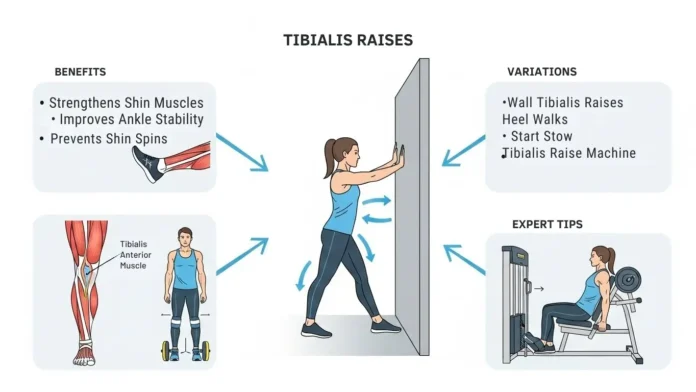
You might hit the gym to train your quads, hamstrings, and calves, but there is a hidden hero in your lower leg that almost everyone ignores. It is the muscle sitting right on the front of your shin, and neglecting it is a major reason why so many people suffer from knee pain, shin splints, and stiff ankles.
Strengthening this muscle with Tibialis Raises (or “Tib Raises”) is one of the simplest, most effective ways to “bulletproof” your lower body. Whether you are a runner trying to run faster, a grandparent wanting to walk without tripping, or just someone who wants pain-free knees, this exercise is your secret weapon.
Below is a quick overview of what this guide covers, followed by everything you need to know to master this movement.
| Goal / Problem | How Tib Raises Help | Best Variation |
| Shin Splints | Strengthens the muscle to handle impact shock. | Wall Tib Raises (High Reps) |
| Knee Pain | Acts as a shock absorber to take pressure off the knee joint. | Weighted Tib Bar Raises |
| Stiff Ankles | Forces the ankle into deep dorsiflexion (flexing foot up). | Full Range Motion Tib Bar |
| Tripping / Falls | Lifts the toes during walking to prevent catching on the ground. | Banded or Wall Raises |
Understand the Tibialis Anterior
The Body’s Natural Shock Absorber:
Your shins take the first hit. Every time you take a step, walk down stairs, or land a jump, force travels up from your foot. The Tibialis Anterior is the first line of defense. It acts like a brake pedal for your foot. If this muscle is weak, it cannot slow your foot down gently. Instead, your foot “slaps” the ground, and that shockwave travels straight up to your knees and hips. Strengthening it turns your lower leg into a high-quality shock absorber.
The Deceleration Superpower:
Most people only train for the “gas pedal.” We love exercises that help us jump high or run fast (like calf raises), which are the “gas.” But you also need “brakes.” The Tibialis Anterior is your main decelerator. It stops your knee from buckling forward too quickly when you walk or run. If you have “all gas and no brakes,” your joints take a beating because your muscles aren’t strong enough to control your movement.
Preventing the “Foot Drop” of Aging:
Tripping is a major risk as we get older. Have you ever noticed older adults shuffling their feet? This is often due to a condition called “foot drop,” where the shin muscle becomes too weak to lift the toes while walking. By doing Tibialis Raises now, you ensure you can lift your toes high for decades to come, significantly reducing the risk of tripping over rugs or uneven sidewalks later in life.
How to Do the Perfect Wall Tibialis Raise

The Setup:
Find a smooth wall and clear floor space. Stand with your back flat against a wall. Your feet should be about hip-width apart. Walk your feet out forward away from the wall. The further out you walk your feet, the harder the exercise will be. For beginners, start with your heels about 12 inches (30 cm) away from the wall.
The Body Position:
Lock your legs and engage your glutes. Lean your butt and shoulders comfortably against the wall. It is crucial to keep your legs straight. If you bend your knees significantly, you might start using other muscles. However, a tiny “micro-bend” is okay to protect the knee joint if you have hyperextension issues, but try to keep them as straight as comfortable.
The Movement:
Pull your toes to the sky. Flex your feet and pull your toes up toward your shins as hard as you can. Imagine you are trying to touch your kneecaps with your big toes. Hold this top position for a split second to feel the burn in the front of your shins.
The Release:
Lower with control, do not drop. Slowly lower your toes back to the ground. Do not just let them slap the floor. The lowering phase is where you build strength and control. As soon as your toes touch the ground, immediately pull them back up for the next rep.
Top Variations for Every Level
The Wall Raise (Bodyweight):
This is the best place to start. As described above, this requires zero equipment. It is perfect for high-repetition sets (20 to 25 reps). It pumps blood into the shin area and heals connective tissue. If it becomes too easy, simply walk your feet further away from the wall to increase the leverage and difficulty.
The Banded Tib Raise:
Use this for isolation and portability. Sit on the floor with your legs straight out. Wrap a resistance band around the top of your foot and anchor the other end to a heavy table leg or a pillar. Pull your toes back against the band. This version is excellent because it provides constant tension at the top of the movement, which is great for muscle growth.
The Weighted Tib Bar Raise:
This is the gold standard for strength. A “Tib Bar” is a specific tool that clamps onto your feet and holds weight plates. You sit on a bench with your legs hanging off and curl the weight up. This allows for “progressive overload,” meaning you can measure your strength gains by adding small weights over time. This is the preferred method for athletes or those rehabilitating serious knee issues.
The Kettlebell Variation:
A gym-friendly alternative to the Tib Bar. If you do not have a Tib Bar, sit on a high bench. Slip your foot through the handle of a light kettlebell so the weight hangs off your toe. Flex your foot up to lift the kettlebell. This works well for single-leg training, helping you fix imbalances if one shin is weaker than the other.
Expert Tips for Maximum Results
High Reps for Healing:
Shins respond best to endurance. The Tibialis Anterior is made of mostly “slow-twitch” muscle fibers, meaning it is built to work all day while you walk. To really train it, you need higher repetitions. Aim for sets of 15 to 25 reps rather than heavy sets of 5. You want to feel a deep burn and a “pump” in the muscle.
Do Not Neglect the Stretch:
Range of motion is the key to ankle mobility. When you lower your toes, try to point them as far down as possible (plantar flexion) before pulling up. If you are using a Tib Bar, let the weight stretch your ankle down at the bottom. This full range of motion strengthens the ankle in every position, not just the top.
Pair It With Calf Raises:
Create balance in the lower leg. Think of your lower leg like a suspension bridge. The calf muscle is the cable on the back, and the tibialis is the cable on the front. If one is tight and strong while the other is weak, the bridge becomes unstable. For every set of calf raises you do, try to perform a set of tibialis raises. This “antagonist” training keeps the ankle joint centered and healthy.
Frequency Matters:
Train them frequently but lightly. You can train the tibialis anterior more often than large muscle groups like hamstrings. Because it recovers relatively quickly, you can do bodyweight Wall Raises 3 or 4 times a week. If you are doing heavy weighted Tib Bar raises, treat it like a normal lift and rest for 48 hours between sessions.
New Insights The “Knee Shield” Concept
Why “Knees Over Toes” Needs Tibialis Strength:
You cannot safely put your knees over your toes without shin strength. There is a popular fitness trend about training your “knees over your toes” to rebuild joints. However, many people skip the first step: the shins. When your knee travels forward over your toe (like walking down stairs), the Tibialis muscle must engage to stabilize the ankle. If you skip this step, the pressure bypasses the muscle and grinds directly into the knee tendon. Build the shin first, and your knees will thank you.
Shin Splints Are Not a Life Sentence:
Stop treating the symptom and cure the cause. Most people treat shin splints with ice and rest. This only reduces inflammation temporarily. The pain usually comes from the muscle being too weak to handle the force of running. By progressively strengthening the muscle with Tib Raises, you increase its capacity to handle load. You are not just healing the injury; you are building a shield so it doesn’t come back.
FAQs
Can I do Tibialis Raises every day?
Yes, if you use bodyweight. The Wall Tib Raise is low-impact and gentle enough to be done daily as a warm-up or part of a morning routine. However, if you are using heavy weights (like a Tib Bar), you should take rest days to allow the muscle fibers to repair and grow stronger.
How long until I see results?
You will feel the difference in weeks. Most people feel a significant reduction in shin pain and “heavy feet” within 2 to 4 weeks of consistent training. For visible muscle growth on the front of the shin, it typically takes 8 to 12 weeks of weighted training.
Do I need to buy a Tib Bar?
No, but it helps for advanced strength. You can get 80% of the benefits just by using a wall or a simple resistance band. The Tib Bar is a great investment only if you have maxed out the difficulty of the wall version or if you are a serious athlete looking to maximize vertical jump and sprint speed.
Will this make my shins look bulky?
It creates an athletic, balanced look. It is very difficult to build “bulky” shins. Instead, developing this muscle gives the lower leg a defined, athletic appearance. It fills out the front of the leg, making the calf look more proportional and the ankle look robust rather than fragile.