


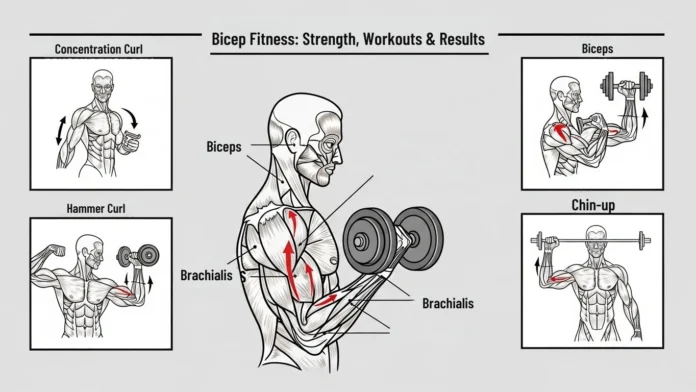
We have all been there, standing in front of the mirror, flexing an arm, and wondering why the results just aren’t matching the effort. You might be hitting the gym consistently, churning out rep after rep of curls, yet your sleeves feel just as loose as they did three months ago. It is a frustrating plateau that almost every lifter faces at some point in their journey. The truth is, building impressive arms requires more than just mindless lifting; it demands a strategy that blends science, consistency, and a deep understanding of how your muscles actually grow. This guide delves into the core aspects of bicep fitness: strength, workouts & results, to help you finally break through that ceiling.
Matching Goals to Exercises:
| Your Primary Goal | Target Muscle Area | Best Exercise | Why It Works |
| Bicep Peak (Height) | Short Head (Inner Bicep) | Preacher Curls | Focuses tension when the muscle is fully shortened. |
| Overall Mass | Both Heads | Chin-Ups | Allows for the heaviest load and recruits maximum fibers. |
| Arm Width/Thickness | Brachialis (Side Muscle) | Hammer Curls | Targets the muscle underneath the bicep to push it up. |
| Stretch & Length | Long Head (Outer Bicep) | Incline Dumbbell Curls | Places the shoulder in extension to stretch the muscle. |
Understanding Bicep Anatomy
The Two Heads of the Beast:
To optimize your bicep fitness: strength, workouts & results, you first need to visualize what lies beneath the skin. The “biceps brachii” is made up of two distinct heads: the long head and the short head. The long head sits on the outside of your arm and is responsible for that “peak” you see when you flex. The short head sits on the inside and provides the width and density when your arm is relaxed or viewed from the front. Most people unknowingly neglect the long head because they only do exercises where their elbows are in front of their body, which limits the potential for that mountain-like peak.
The Secret Muscle for Thickness:
There is a hidden player in arm training that often gets ignored, yet it is the key to thick, powerful-looking arms. The brachialis is a muscle that runs underneath the biceps. When you train this muscle specifically, it actually pushes your bicep upward, making your arm look significantly larger and wider. Neglecting the brachialis is a primary reason why many people have “flat” looking arms even if they do endless curls. Incorporating neutral-grip movements is the only way to wake up this sleeping giant and add immediate visual size to your upper arm.
The Foundation of Strength
Why Strength Equals Size:
Many gym-goers fall into the trap of thinking that high reps and a “pump” are all that matter for growth. While getting a pump feels great, true bicep fitness relies on progressive overload, which means getting stronger over time. If you are curling the same 20-pound dumbbells today that you were curling last year, your arms have no reason to grow. You need to focus on increasing the weight or the reps on your compound movements, like chin-ups and heavy barbell curls. These heavy lifts recruit the fast-twitch muscle fibers that have the highest potential for growth.
Functional Benefits of Strong Arms:
Beyond just filling out a t-shirt, bicep strength plays a crucial role in your overall athletic performance and daily life. Your biceps are major stabilizers for the shoulder and are heavily involved in any pulling motion, such as deadlifts, rows, and even carrying groceries. Weak biceps can actually become a bottleneck for your back training; if your arms tire out before your lats do during a row, you will never fully develop your back. Therefore, treating your biceps as a strength muscle, rather than just a vanity muscle, will have a carryover effect on your entire physique.
Structuring Your Workouts
The Importance of Elbow Position:
The angle of your shoulder and the position of your elbow dictate which part of the bicep does the heavy lifting. If you want to build a complete arm, you cannot just do three variations of standing curls. You must include exercises where your elbows are behind your body (to stretch the long head), exercises where your elbows are by your side (for general mass), and exercises where your elbows are in front of your body (to squeeze the short head). This multi-angle approach ensures that no fiber is left unstimulated.
The “Stretch” Workout for the Long Head:
To target the long head and build that peak, you need to put the muscle in a fully stretched position. The Incline Dumbbell Curl is the king of this category. Set a bench to a 45-degree angle, sit back, and let your arms hang straight down behind you. As you curl, keep your elbows locked in that backward position. You should feel a deep, intense stretch in the meaty part of your bicep and even into your shoulder. This “stretch-mediated hypertrophy” is a powerful signal for muscle growth that standard curls simply cannot provide.
The “Squeeze” Workout for the Short Head:
The short head is best targeted when your elbows are positioned in front of your body. This is where the Preacher Curl or the Spider Curl shines. Because your arms are supported and forward, the long head becomes “actively insufficient,” meaning it cannot contribute as much force. This forces the short head to take the brunt of the load. Focus heavily on the top of the movement here; squeeze as hard as you can for a full second at the peak of the contraction to drive blood into the inner bicep.
The “Width” Workout for the Brachialis:
To widen the arm, we must shift the focus to the brachialis and the brachioradialis (the forearm muscle). The Hammer Curl is your go-to movement here. Instead of twisting your palm up, keep your palms facing each other throughout the entire movement, like you are holding a hammer. You can do these across your body or straight up and down. This neutral grip takes the biceps out of their strongest position and forces the deeper arm muscles to work. This is the quickest way to make your arms look thicker from the front view.
Maximizing Your Results
The Role of Tempo and Control:
One of the biggest mistakes in bicep training is using momentum to swing the weight up. If you have to rock your hips to get the dumbbell moving, you are training your lower back, not your biceps. For maximum results, you should use a controlled tempo. Try taking one second to lift the weight, squeeze for one second at the top, and then take three full seconds to lower the weight. That slow lowering phase, known as the eccentric, is where the majority of muscle damage and subsequent growth occurs.
Frequency and Recovery:
Your biceps are a relatively small muscle group, which means they recover faster than large muscles like your legs or back. However, they are also easily overworked because they are used in every back workout. For most natural lifters, training biceps directly twice a week is the sweet spot. This frequency allows you to hit them hard with high intensity, while still giving them 48 to 72 hours to repair and grow. If you train them every single day, you interrupt the recovery process, and your growth will stall.
Nutrition for Arm Growth:
You cannot out-train a poor diet, and this applies to arm growth just as much as any other body part. To support the bicep fitness: strength, workouts & results you are chasing, you need to be in a slight calorie surplus. Muscle tissue requires energy to be synthesized. Ensure you are consuming enough protein—roughly 0.8 to 1 gram per pound of body weight to provide the building blocks for new muscle tissue. Hydration is also key; a dehydrated muscle loses volume and strength, making your pumps lackluster and your workouts less effective.
Real Talk on Timelines
The First 4 Weeks:
When you start a new bicep program, the first thing you will notice is not necessarily size, but “tone” and a neurological strength increase. During the first month, your nervous system is becoming more efficient at recruiting muscle fibers. You might feel harder and look slightly more vascular, but tape-measure changes will be minimal. Do not get discouraged during this phase; these invisible adaptations are laying the groundwork for the visible growth that follows.
Weeks 8 to 12:
This is the window where the magic starts to happen. If you have been consistent with your progressive overload and nutrition, you should start seeing a visible difference in the shape of your arm. Your sleeves might feel tighter, and you will notice more separation between the bicep and the tricep. This is typically the point where friends or family might ask if you have been working out. It is crucial to keep pushing during this phase and not become complacent with your progress.
The Long Game (6 Months +):
Building significant mass, such as adding an inch to your arms, is a long-term project that takes six months to a year of dedicated effort. Muscle growth is a slow biological process. Consistency over this long haul is what separates those with “okay” arms from those with “impressive” arms. Trust the process, track your lifts, and celebrate the small wins in strength, because those strength gains will eventually materialize as size.
Advanced Tips & Common Mistakes
Avoiding the “Wrist Curl” Trap:
A subtle but damaging mistake many lifters make is curling their wrists at the top of the movement. When you curl your wrist toward your face, you shift the tension from your bicep to your forearm flexors. To keep the tension purely on the bicep, try to keep your wrist slightly extended or neutral throughout the lift. Imagine you are trying to touch the inside of your elbow with your pinky finger, rather than just moving the weight from point A to point B.
The Danger of Junk Volume:
Doing endless sets of light curls at the end of a workout is often referred to as “junk volume.” It fatigues the central nervous system without providing enough mechanical tension to stimulate growth. Instead of doing 10 sets of mediocre effort, focus on doing 3 to 4 sets of extremely high intensity, taking each set close to muscular failure. Quality always trumps quantity when it comes to hypertrophy; your biceps grow from the intensity of the contraction, not the duration of your time in the gym.
FAQs
Can I train biceps every day?
Training biceps every day is generally not recommended for natural lifters. Muscles grow during rest, not during the workout. If you train them daily, you never give the tissue time to repair, which can lead to overtraining and stagnation. Stick to 2 or 3 times per week for the best results.
Which exercise is best for the bicep peak?
The Preacher Curl and the Spider Curl are the best exercises for the peak. These movements place the elbows in front of the body, which emphasizes the short head of the bicep. Additionally, focusing on supination (twisting your pinky finger upward) at the top of any dumbbell curl will help heighten the peak.
How much weight should I lift for biceps?
You should lift a weight that allows you to complete 8 to 12 reps with perfect form, reaching failure or near-failure on the last rep. If you can easily do more than 15 reps, the weight is too light. If you cannot complete at least 6 reps without swinging, the weight is too heavy.
Why are my biceps not growing?
The most common reasons for lack of growth are poor form (using momentum), insufficient calories (under-eating), or lack of progressive overload (not increasing weight over time). Ensure you are controlling the weight, eating enough protein, and slowly adding weight to the bar every few weeks.
Do push-ups work biceps?
Standard push-ups primarily target the chest, triceps, and shoulders. They do not significantly work the biceps. If you want to train your biceps with bodyweight, chin-ups or inverted rows are the most effective exercises.