


Home cooking recipe nutrition calculator puts you in complete control of every ingredient that goes into your body, yet most home cooks dramatically underestimate portions and energy density. A tablespoon of olive oil becomes “a drizzle,” a handful of cheese becomes “a sprinkle,” and suddenly a “light” chicken stir-fry delivers 900 kcal instead of the expected 450. Without precise measurement, even the healthiest recipes can sabotage fat loss, muscle gain, or metabolic health goals.
Recipe nutrition calculator eliminate that blind spot. Enter your exact ingredients and quantities, and the tool instantly delivers a complete breakdown: calories, protein, carbohydrates, fats, fiber, sugars, sodium, and key micronutrients. The best calculators pull directly from the USDA FoodData Central database — the same reference standard used by registered dietitians, researchers, and federal nutrition policy — so the numbers are as reliable as a laboratory analysis.
The Hidden Cost of Guessing Nutrition
Energy balance determines body-weight change. Consume more calories than you expend and you gain weight; consume fewer and you lose weight. The equation is straightforward, but executing it in real life is not, because humans are remarkably poor at estimating intake.
When individuals simply write down or log what they eat, they lose significantly more weight than those who do not. The most comprehensive early review of behavioral weight-loss trials found that consistent dietary self-monitoring was the single strongest predictor of success, with adherent participants losing roughly twice as much weight as non-adherent ones (Self-Monitoring in Weight Loss: A Systematic Review of the Literature, Journal of the Academy of Nutrition and Dietetics, 2011). More recent analyses confirm the same pattern: higher adherence to food logging correlates with greater weight loss and better long-term maintenance.
In 2024 the Centers for Disease Control and Prevention reported that 40.3 % of U.S. adults had obesity based on measured data from the National Health and Nutrition Examination Survey collected August 2021–August 2023 (NCHS Data Brief No. 508, September 2024). Precise tracking is one of the few evidence-based tools that reliably moves the needle on that statistic at the individual level.
Why Macros Matter More Than “Eating Clean”
Calories set the direction of weight change, but macronutrients determine body composition and how sustainable the process feels.
Protein:
During energy restriction, higher protein intakes preserve lean mass. A 2017 review concluded that protein intakes above the RDA (roughly 1.2–1.6 g/kg/day versus the standard 0.8 g/kg) during calorie deficits result in 400–800 g greater retention of fat-free mass over 12–16 weeks (Preserving Healthy Muscle during Weight Loss, Advances in Nutrition, 2017). A 2024 meta-analysis of adults with overweight or obesity undergoing weight-loss interventions found that enhanced protein intake significantly prevented loss of muscle mass with a standardized mean difference of 0.75 (Enhanced protein intake on maintaining muscle mass, strength, and physical function during weight loss in adults with overweight or obesity: A systematic review and meta-analysis, Clinical Nutrition ESPEN, 2024).
The International Society of Sports Nutrition’s 2017 position stand recommends 1.4–2.0 g protein per kg body weight per day for exercising individuals, with higher ranges (up to 2.3–3.1 g/kg in large deficits) when the goal is fat loss with maximal muscle retention (International Society of Sports Nutrition Position Stand: protein and exercise, Journal of the International Society of Sports Nutrition, 2017).
Carbohydrates and Fats:
Carbohydrates and fats provide the remaining calories, and the optimal ratio depends on context. Low-carbohydrate diets can improve satiety and glycemic control in insulin-resistant individuals, while higher-carbohydrate approaches often work better for high-volume training. What matters universally is hitting your chosen targets something almost impossible without measurement.
Fiber:
Fiber deserves its own spotlight. Higher dietary fiber intake is associated with lower body weight, better lipid profiles, and reduced incidence of cardiovascular disease, type 2 diabetes, and several cancers. An umbrella review of systematic reviews and meta-analyses of prospective studies concluded that each additional 8 g/day of dietary fiber reduces total mortality by 10 % and cardiovascular events of coronary heart disease, type 2 diabetes, and colorectal cancer by 5–27 % (Dietary fiber and health outcomes: an umbrella review of systematic reviews and meta-analyses, American Journal of Clinical Nutrition, 2019).
A recipe calculator displays fiber per serving so you can see at a glance whether your “healthy” chili” delivers 15 g or 3 g.
Home Cooked Meals Are Healthier
Frequent consumption of meals prepared away from home is associated with higher energy intake, greater body fat, and increased risk of all-cause mortality. Adults who ate meals prepared away from home two or more times per day had a 49 % higher risk of all-cause mortality and a 67 % higher risk of cardiovascular mortality compared with those who ate such meals less than once per week, even after adjusting for multiple confounders (Association Between Frequency of Eating Away-From-Home Meals and Risk of All-Cause and Cause-Specific Mortality, Journal of the Academy of Nutrition and Dietetics, 2021).
Conversely, adults who cook dinner at home most nights consume fewer calories, less fat, less sugar, and more micronutrients than those who rarely cook. Cross-sectional data repeatedly show that greater time spent on home food preparation correlates with higher Healthy Eating Index scores, higher fruit and vegetable intake, and lower adiposity (Time Spent on Home Food Preparation and Indicators of Healthy Eating, American Journal of Preventive Medicine, 2014).
The advantage disappears, however, when home recipes are unintentionally calorie-dense. Many popular online recipes underestimate energy by 20–50 % because they use vague terms like “a splash” of oil or “a handful” of nuts. A calculator forces precision and restores the health edge to home cooking.
How Accurate Recipe Nutrition Calculators Actually Work

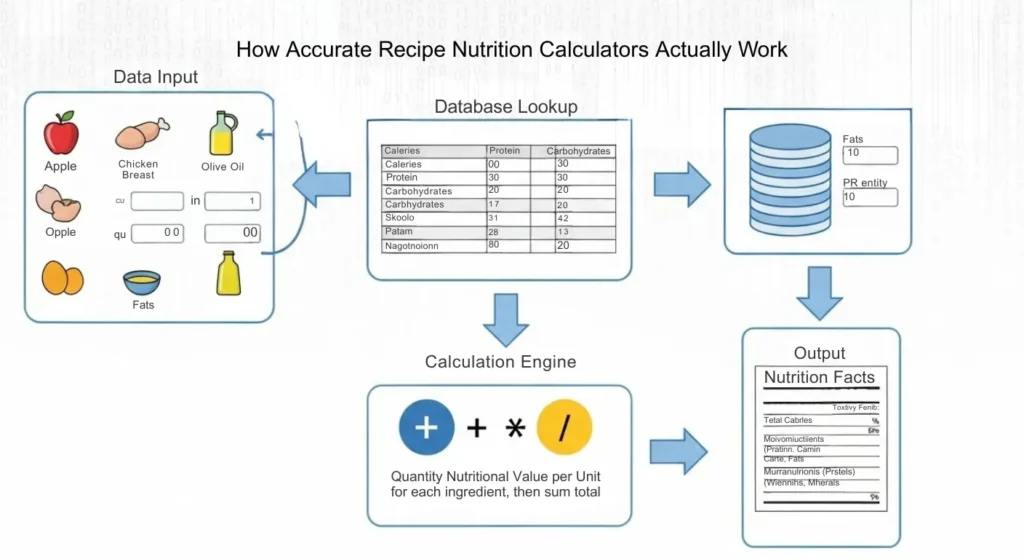
Modern recipe calculators are built on the USDA FoodData Central database, which contains analytical and imputed nutrient values for over 300,000 foods and is continuously updated by the Agricultural Research Service. The database includes retention factors (how nutrients survive cooking), yield factors (weight change during preparation), and refusal factors (inedible parts), making it the most comprehensive public nutrient repository in the world.
When you enter “200 g raw chicken breast, skinless,” the tool knows that after pan-searing it weighs approximately 150 g and retains 98 % of its protein but loses some B vitamins. It applies the correct factors automatically. Independent validation studies show that calculators using USDA data agree with laboratory chemical analysis within 5–10 % for most macronutrients when ingredients are weighed accurately.
Real Recipes, Real Numbers
Overnight Oats:
- 200 g rolled oats
- 800 ml unsweetened almond milk
- 40 g chia seeds
- 400 g Greek yogurt 0 % fat
- 200 g mixed berries
Many people assume this is ~300 kcal per serving. The calculator shows 428 kcal, 26 g protein, 52 g carbs, 14 g fat, 12 g fiber. The surprise usually comes from the chia seeds and the fact that 200 g dry oats is far more than “two cups” feels like.
“Healthy” Chicken Curry:
- 1 kg chicken thigh, skinless
- 400 g full-fat coconut milk
- 3 tbsp oil for cooking
- rice, spices, vegetables
Without measuring oil and coconut milk, most cooks guess 550–600 kcal per portion. Actual: 812 kcal, largely from the coconut milk and accumulated cooking oil. Swapping light coconut milk and reducing oil to 1 tbsp drops it to 580 kcal with almost no taste difference a 1,400 kcal weekly saving if eaten twice.
These examples illustrate why “intuitive eating” works for maintenance but rarely for deliberate fat loss or muscle gain.
Micronutrients The Often Ignored Bonus
Beyond macros, a good calculator reveals vitamin and mineral shortfalls. A vegan lentil soup might hit protein targets but fall short on B12, zinc, and iron bioavailability. A keto salmon with broccoli might lack potassium and magnesium if portions aren’t tracked. Seeing the numbers encourages small tweaks — a handful of pumpkin seeds here, a squeeze of lemon there that prevent deficiencies without supplements.
Who Actually Needs a Recipe Calculator:
- Fat-loss clients who plateau despite “eating clean”
- Strength athletes chasing 1.6–2.2 g/kg protein daily
- People with diabetes or PCOS managing carbohydrate load
- Parents wanting to know exactly what their children eat
- Meal-prep enthusiasts scaling batches accurately
- Anyone following therapeutic diets (Mediterranean, DASH, plant-based, etc.)
The Future Proofing Your Nutrition
Nutrition science evolves, but the need for accurate data does not. As wearable devices improve expenditure estimates and continuous glucose monitors become mainstream, the missing piece remains precise intake data. Recipe calculators close that gap today and integrate seamlessly with tomorrow’s tools.
Start with weighed ingredients for two weeks. The initial effort feels tedious, but the insight is transformative. Most users discover they were previously under-eating protein, over-eating fats, or both and once corrected, progress accelerates.
References:
- Self-Monitoring in Weight Loss: A Systematic Review of the Literature. Journal of the Academy of Nutrition and Dietetics, 2011.
- Preserving Healthy Muscle during Weight Loss. Advances in Nutrition, 2017.
- Enhanced protein intake on maintaining muscle mass, strength, and physical function during weight loss in adults with overweight or obesity: A systematic review and meta-analysis. Clinical Nutrition ESPEN, 2024.
- Association Between Frequency of Eating Away-From-Home Meals and Risk of All-Cause and Cause-Specific Mortality. Journal of the Academy of Nutrition and Dietetics, 2021.
- Health benefits of dietary fiber. Nutrition Reviews, 2009.